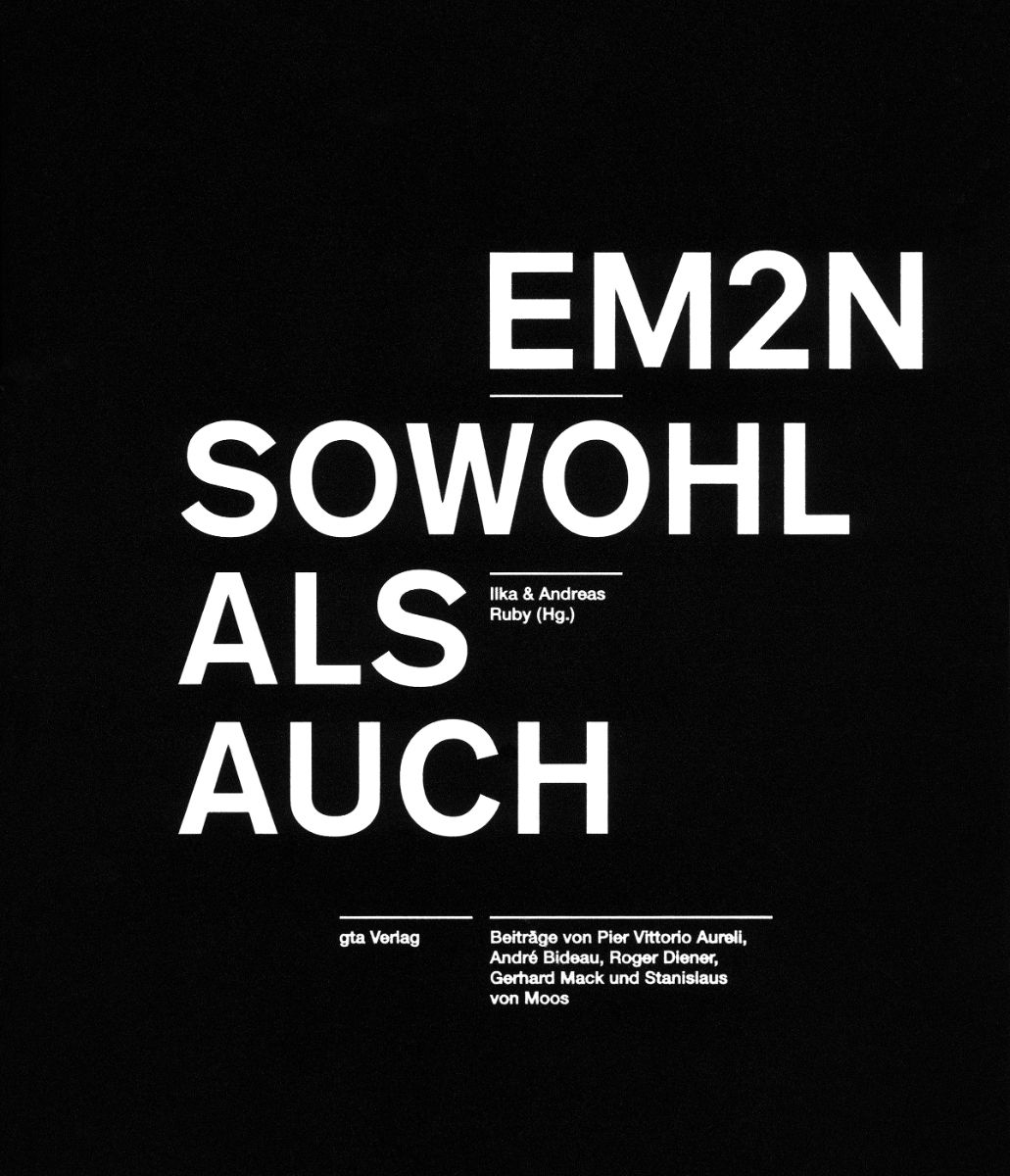
How We Became Who We Are – A professional biography of EM2N
Part I
Conceived by Ilka & Andreas Ruby
Told by Mathias Müller and Daniel Niggli
Published in EM2N – Both and, 2009
Mathias Müller (M) Daniel and I have known each other since the very first day of our studies at the ETH Zurich in 1989.
Back then around 350 students started to study architecture each year. By chance we happened to be in the same booth. In your first
year you had to study under Herbert Kramel. Bernhard Hösli had reinvented the ‘basic level course’ and in the process had revolutionised architectural education
at the ETH. He taught in a very lively, flexible way. Under Kramel this lively approach to teaching gradually lost its vigour and became
dry and desiccated. For years the student work was always done in Sabbioneta, an ideal town in northern Italy, in an undeveloped sector of
the town and according to a strict educational context. You were given thin strips of paper that you had to bend and fold so
that they made volumes. You made ten of them, positioned them in relation to each other, and then talked with the teachers about in-between
spaces and series. Absurdly, Sabbioneta’s importance as an ideal Renaissance town was never looked at. In principle the whole thing could have taken place
on the periphery of Zurich, as for semesters all people did was just move strips of paper around.
Daniel Niggli (D) All that I have
retained from Kramel is a saying by Karl Kraus that he regularly quoted: ‘Cosy is something I already am myself’ (1) – we’ve even
used this occasionally with clients who found our design too atmospherically cold. All in all, the first year was a year lost, completely different
to the current first-year programme that Marc Angélil built up in the late 1990s. That has a completely different drive, an entirely different intensity.
The students are challenged, confronted with design techniques, literature and theory, and as a consequence are really motivated to make something exciting. The atmosphere
under Kramel was utterly flaccid. There was never the slightest hint of urgency, never the feeling that you might miss something. In the second
year, things became more fascinating, with different professors such as Arthur Rüegg, Flora Ruchat and Helmut Spieker.

Fig. 1: Aurelio Galfetti, Flora Ruchat- Roncati, Ivo Trümpy, Public Swimming Pool Complex Bellinzona, 1967–1970
M Flora Ruchat was interesting; we have looked at her
Swimming Pool in Bellinzona on several occasions. She represented the ‘Tendenza’, which was still very fresh at the time. There was this big red
book that Thomas Boga published himself, containing all the projects. (2) On the weekend we used to ride on our Vespas down to Ticino
and look at the houses by Snozzi and Galfetti, we scrambled around in the garden and got collectively intoxicated by the concrete.

Fig. 2: Arthur Rüegg (ed.), Polychromie architecturale – Le Corbusiers Farbenklaviatur von 1931 und 1959, Basel 1997
D Arthur Rüegg has a profound knowledge of
classic Modernism, and especially Le Corbusier. A real researcher and teacher! His second-year programme was very much based on constructive thinking, it was clearly structured
and systematic, and actually, he would have been the perfect man for the first year.

Fig. 3: Helmut Spieker, University Buildings Marburg, 1964
M Nobody wanted to go to Helmut Spieker – and we promptly landed with him. But this
wasn’t a problem for us; he was a charismatic guy, he had intelligent eyes, white bushy eyebrows, and he was a great story-teller, rhetorically
gifted. He was a chain smoker and every time he lit up a cigarette, it was like a small performance: after lighting the cigarette,
he held the match in his hand for so long that the flame almost burnt his fingers. He then extinguished the flame with a
cutting movement, the match and ash fell on the needlecord carpet in front of the spellbound spectators. Spieker had started off as a ‘systemised-building
guy’. The Marburg building system was his idea. In fact his approach was highly philosophical and infl uenced us indirectly. He wasn’t primarily so
interested in designing individual buildings, he thought more in terms of formal and urban planning principles, almost like Lego. First of all, you design
the Lego system, then, out of it, you can develop all possible kinds of things. Of course, we quickly realised that this approach had
its limitations. Whatever you produced with it would never be a unique piece, but always a derivative of the system.
D And, as a good
old modernist, he was, of course, also very dogmatic. For him the massively built house was taboo, he saw this in a really political
way. In his book Totalitäre Architektur (Totalitarian Architecture) he settles an account with every form of monumentality. (3) As far as he was concerned,
there was just the modern skeletonframe building that was developed by putting parts together – columns, slabs, curtain wall. De Stijl deeply influenced him,
as indeed did Dutch Modernism as a whole. Egon Eiermann was probably his God. The term ‘place’ was one he never used.
M This became
clear in a rather absurd way during an integrated art exercise which involved the students going to their building site where they were meant
to collect ‘impressions’ of the genius loci. Spieker, who regarded this as postmodern nonsense, deliberately assigned us a site in Bassersdorf, part of the
mushy urban sprawl surrounding Zurich. Basically, it was a field in an industrial area, beside a tennis centre, between a railway line and a
few cash-and-carry markets. We made sketches there for a week. The whole thing was unintentionally comical, but all the same, it affected us deeply,
eve though we didn’t grasp this at the time.
D Later, during the preparation semester for our master thesis, we repeated this exercise. At that
time we had a diffuse notion that, although there is nothing special to ‘sense’ out there, the reality that exists is nevertheless a reality
that you can work with. Seen from a current viewpoint it was a mix of the ‘as found’ of the Smithsons, with their genuine
empathy for everything that exists, and Koolhaas’ ‘dirty realism’, with his secret sympathy for the accidents of reality. Back then, we began not just
to concentrate on the site alone, but also to take an interest in what goes on around it. And above all, we focussed on
the fact that you can make something out of everything. If you are stuck in Bassersdorf for a week, then you just make something
out of Bassersdorf.

Fig. 4: Hans Kollhoff, Museum of Ethnology, Frankfurt, 1982
M At the same time, the disciples of Miroslav Šik and Fabio Reinhardt were going around
the ETH. For Spieker these were the totalitarians, a kind of sect. They drew A0 perspectives with thick lines and spent nights colouring them
with Jaxon crayons. The whole floor of the building was filled with this typical smell. You could smell where Šik was at a distance
of fifty metres, with the wind coming from the other direction. Of course, this absolutely fascinated us. You could hardly get into the
discussion booth at Šik’s final crits, because so many people wanted to be there. At the front was the master with his devilish grin,
at his feet the chain-smoking satanic disciples, it was really intense. A lot of good architects have emerged from this group – Andrea Deplazes,
Christian Kerez, Valerio Olgiati, Andreas Hild and many others.

Fig. 5: Axel Fickert, Marcel Meili, Miroslav Šik, Stock Exchange Selnau, Zurich, 1980
D Šik and Reinhardt were probably formative figures for an entire generation
of ETH graduates, comparable with, say, Rossi years earlier. With their interest in the everyday, atmosphere, tradition in fact they’re not all that far
removed from ‘as found’ and ‘dirty realism’. And then, of course, there was Hans Kollhoff, in his wild phase. Great projects were produced during
this time, and many of those who were students then are still known today. In contrast hardly any of Spieker’s disciples are still completely
involved in the profession. Spieker’s chair was a rather abnormal biotope; some of our basic architectural reflexes were certainly irreversibly damaged there.
M After the second year with Spieker came the work experience period, which I spent in the architecture department of Karl Steiner. This was
one of the big general contractors in Switzerland who had the vision of being a total contractor and wanted to supply a design and
construction package from a single firm. Spieker was the head architect there …

Fig. 6: Claude Paillard, City Theatre, St. Gallen, 1968
D I went first of all to Claude Paillard who had built the City Theatre in
St. Gallen, a really great building. He was strongly influenced by Alvar Aalto and had an unbelievable feeling for the ‘promenade architectural’. His spaces
are internal landscapes, a theme that was later to become very important for us. He was a somewhat strange person, he always sat alone
in his room with just his dog beside him, his staff had all been with him for years and as a work experience student
you hardly ever caught sight of him. But in his archive I discovered really exciting old projects and competitions. Of the buildings he carried
out, the Stepped Apartment House in Eierbrechstrasse in Zurich impressed me. In his own house you could transform the living room by using round
sliding walls. I think I retained a few impressions, more or less unconsciously, but today I can see how they formed me.

Fig. 7: Claude Paillard, Stepped Apartment House Eierbrechtstrasse, Zurich, 1959

Fig. 8: Claude Paillard, House, Zurich, 1978–1981
M After six months with Karl Steiner I had had enough and then I built a single-family house in the Bernese Oberland with a
colleague. Building a house for the first time, drawing details that were actually carried out, that was a real awakening.
D Then I went to
the USA to Scott Marble and Karen Fairbanks, and afterwards to Tod Williams and Billie Tsien; I earned the money to do this with
Steiner.

Fig. 9: Herzog & de Meuron, Library at Eberswalde University of Applied Sciences, 1998
M After the first year of practical work experience we were
once again confronted with the big question about whom we should study with. Up until then we hadn’t really learned all that much. When
I heard what others had experienced during their practical year – the cool ones went to OMA and Herzog & de Meuron, who were
just becoming known around that time – it dawned on me that perhaps I had missed something during this year. You were assigned to
a particular professor by means of a computerised selection process. I landed with Walter Arno Noebel, who was responsible for Ungers’ indescribable Messe in
Frankfurt. First Spieker, then an Ungers’ disciple, I mean the two couldn’t have been more different. The programme consisted of huge houses, and a
department store on Sechseläutenwiese, and I filled this sacred Zurich meadow with a deep building. For me the most important thing about this studio
was the contact with the teaching assistants, Erik Steinbrecher and Thomas Dietzsch. Thomas was the son of Ungers’ office manager. He took me under
his wing and together we drew up an Europan project. He advised me to take another work experience period and set up a contact
to Herzog & de Meuron for me. In retrospect, I have the feeling that that is where my studies really started. At the time
there were around 35 people working for Herzog & de Meuron and you really had the chance to experience Jacques and Pierre. They were
working on Eberswalde back then. I found the idea of printing something on the building absolutely impossible, non-architectural so to speak. Naturally, I also
said this to Jacques, which was wonderfully naïve of me. That this was a calculated breaking of a taboo was something I didn’t properly
understand. At some time or other, it became clear to me that they constantly question the ‘rules of etiquette’ of architecture and break them
in an intelligent manner. I experienced there, in an extreme way, the freedom that you can take as an architect. After two semesters with
Noebel I went to Mirko Zardini for a semester, today he’s the director of the Canadian Centre for Architecture in Montreal. Although he had
an office, he never designed much there, he tended more to write texts and to theorise. He temporarily filled in for Mario Campi. In
the context of the ETH, his design projects were completely crazy; the focus was on the periphery and its supposed non-places. For example, we
redesigned an Ikea, developed spatial implementations of an Ikea catalogue or drew a car park that functioned like a port so as to dramatise
arrival by car. The results were loud, colourful and also relatively uncontrolled.


Fig. 10: Mathias Müller, Semester Project Department Store Sechseläutenwiese, Zurich, Prof. Walter Arno Noebel
D While Mathias was with Noebel, I went to Adrian Meyer. There I came into contact with the German-speaking Swiss scene for the first
time, among the visiting critics were Roger Diener, Peter Märkli and people like that. In their designs the students used Diener-like forms, which were
really quite well imitated. I quickly realised how far removed my interests were from what was en vogue in Switzerland at the time. People
like Paillard were not ‘in’ here. The semester project dealt with the Schoeller grounds, an old industrial site in Zurich. I found that exciting
and experimented with the existing fabric, looking for transitions between old and new and examining the circulation structures in depth. Many people just cleared
away the existing buildings and occupied the site with Swiss brand architecture. In a kind of masochistic move, I then went to the ‘new’
Kollhoff, which was a complete contrast, a pointless semester. The
project was in Berlin, somewhere in the east of the city. Kollhoff had decided upon
the urban planning aspects, each of us just had to design a building. But this was also predetermined – tectonic stone façades – and
so, in fact, the design was ready before you had even started it. Then came my second work experience period: first of all, I
was with Dolf Schnebli and from there I went to the USA again, for an exchange semester at Rhode Island School of Design (RISD)
in Providence. This was rather absurd, but also extremely inspiring, simply a completely different world. RISD is in fact an art university with a
small architecture department. The semester project was rather abstruse. For the first three weeks, we did nothing other than read Plato, Derrida and Deleuze.
We debated for hours about ‘the inside, the outside and the other side’. And we could never agree about the latter. Finally, you had
to build concept models from the texts, look for a site and invent a programme. I tried to do this, but how and why
things had to be this way was a complete mystery to
me – and has remained so to the present day. So I designed what
I liked – complex spatial and sectional figures that describe a route through a building. For me, this was very far removed from the
ETH, but for the teachers there it was still far too concrete, far too architectural … But it was a valuable experience, because it
made it clear to me that I wanted to develop spaces from architecture and not from texts by Deleuze. (4)


Fig. 11: Daniel Niggli, Semester Project at Rhode Island School of Design (RISD), Prof. Philip Parker
Then I read Delirious New York for the first time and I found that this kind of observation and interpretation of reality gives me
far more than dealing with philosophy. (5) For the same reason I found Venturi very stimulating. Matthias experienced the same with Zardini, when they
used the Nolli plan – which Venturi had drawn with his students for Las Vegas – as an instrument for a design in Spreitenbach.
When I came back from the USA we had a free semester before the diploma work and we had an opportunity to deepen all
these impulses. We moved away from the city and sought out the peripheral urban area, the popular and ‘not-beautiful’ – and the photos of
agglomerations by Fischli / Weiss were an important source of inspiration.


Fig. 12: Robert Venturi, Denise Scott Brown, Analysis of the Las Vegas Strip, 1972

Fig. 13: Peter Fischli, David Weiss, Housing Developments, Agglomeration, 1993
Infrastructures and landscape
M So was Kevin Lynch’s Image of the City, for example. (6) We organised our own seminar week and went to Barcelona to look
at and document peripheral urban spaces there – motorway car parks like Nus de la Trinitat or Olympia projects like Vall d’Hebron. What fascinated
us was how an infrastructure can become public space. This is possible only when, in principle, you regard landscape and traffic infrastructures – in
whatever form – as part of the city, instead of classifying them as its opposite. At places where the urban mesh frazzles you achieve
more with landscape than with buildings, because the space in question is so large that you can’t handle it properly just using buildings. You
can only manage this with programmes that are related to landscape in terms of both character and scale.

Fig. 14: Enric Batlle, Joan Roig, Parque de la Trinitat, Barcelona, 1990–1993
D We believed that there were two important references in dealing with urban space that, while not occupied by buildings, is still defined, and
they have maintained their hold on us, long after getting our degree. One is the Melun-Sénart project by OMA, a manifesto for empty space
that is not empty and undefined, but full of potential and specifically ‘framed’. The various traffic infrastructures and public green spaces become generating elements
of the city, whereas the mass of buildings remains indeterminate. And the other is the study on Basel – ‘Eine Stadt im Werden?’ by
Herzog & de Meuron – which examines the landscape, geographical and geological circumstances of the city. What interested us was the very different ways
in which these two studies read the city: Herzog & de Meuron approached the city on a phenomenological figurative level, OMA on a pragmatic
infrastructure level. We found both stories exciting and we tried to superimpose them.

Fig. 15: OMA Rem Koolhaas, Melun-Sénart Competition, Paris, 1987

Fig. 16: Herzog & de Meuron, Meili, Peter, Park for the Avenida Diagonal, Barcelona, 1989

Fig. 17: Herzog & de Meuron, Rémy Zaugg, Eine Stadt im Werden?, Basel, 1991/92
M One consequence for us was an awareness that making an
urban space can be extended over a period of ten or twenty years. In this process it is not necessarily the architecture that makes
a start but, under certain circumstances, temporary events can anchor the place in the consciousness. Later landscape elements come along, for instance trees, which
give urban space a preliminary structure. Trees become a material that forms urban space, which then condenses as the trees grow. The expensive street
network is built only at a relatively late stage in this process, as an immediate precondition for the buildings.

Fig. 18: Marcel Meili, Markus Peter, Albtal Study, 1990/91
D We came to the city in an entirely paradoxical way: via the periphery to the
centre, via ‘nothing’ to the city. Marcel Meili’s ‘Brief aus Zürich’ threw some light on this matter. (7) In it he describes the forces
that form Switzerland. Meili, Peter later made the Albtal Study (1990/91), which for us represented an entirely new way of thinking about urban design.
In it they positioned buildings in space so as to precisely channel the wind blowing through the valley. In conjunction with a new park
and various irrigation systems, the town of Ettlingen (D) would have been given a different climate due to this wind flow. For us, this
still remains one of their most powerful projects, along with Diagonal Barcelona from 1989, which they conceived together with Herzog & de Meuron. We
found the idea of articulating a sewage treatment plant as a park utterly fascinating, partly because this radically expands the term ‘urban design’, that
is to say urban design can be seen as the integrative linking of architecture infrastructure, landscape and ecology, rather than simply what you can
see in a white 1:500 model, as Urs Primas once put it.

Fig. 19: EM2N, Schweingruber Zulauf, Zulauf Schmidlin, Sphinxmatte Solothurn, commissioned study 2001/02
M Ultimately, the focus is here on activating outdoor space – a theme
we’re very interested in. This has to do with the specific figure ground relationship of the city in the Swiss context, which is often
more like a collection of buildings than a continuous mesh. Therefore architectural space cannot restrict itself to the space defined by a building, but
must also include the external space that the building addresses. This sustained interest in external space is, on the one hand, the result of
our elective semester on the peripheral urban landscape. On the other hand it comes from an intensive dialogue with landscape architects Rainer Zulauf and
Lukas Schweingruber, with whom we mostly discuss questions of urban planning. When we had urban planning projects where the programme was undefined, or projects
intended to develop over a very long period, we often initially used greenery, that is to say trees or other landscape elements. In projects
like the Sphinxmatte Solothurn or Easy Olten we used this method to produce the spatial structure of the place.

Fig. 20: EM2N, Urs Primas, Schweingruber Zulauf, Olten Süd-West, commissioned study 2002
D Later, we realised that you don’t always have to fill emptiness, but that you can place a single, specifically shaped architectural object in
such a way that space is no longer undefined. Somewhat like in convex Baroque complexes, the spatial focus of the architectural object is outside
the object itself. Rudolf Arnheim explains this spatial phenomenon and its uses in The Dynamics of Architectural Form. (8) Our competition design for the
extension to a school in Rüti was one such attempt among others. In defining another approach Martin Steinmann used the term ‘constellation’, which essentially
describes the spatial potential of the fields of force and fields of relationships of individual volumes or objects in relation to each other. Essentially
all these strategies are different forms of an urban ‘management of constraints’. Because in this part of the world urban planning is rarely carried
out according to a master plan, but instead a piece is always added to the existing built city, every project, no matter whether architectural
or urban in scale, is exposed to a field of forces made up of very different constraints, and you have to deal with these.
This then led us to describe part of our projects as ‘relational objects’.
Convex / concave:


Fig. 21: Antonio Filarete, Piazza Ducale, Vigevano, 1492


Fig. 22: EM2N, Community Centre Aussersihl, Zurich, 1999–2004, competition design, reworked floor plan, project as built

Fig. 23: Filippo Raguzzini, Piazza di S. Ignazio, Rome, 1727–1735


Fig. 24: Alvar Aalto, Alvar Aalto Museum, Jyväskylä, 1973
Constellations:

Fig. 25: Hugo Häring, Gut Garkau, Ostholstein, 1924–1926

Fig. 26: Piero della Francesca, The Ideal City, 1475

Fig. 27: Bernd Becher, Hilla Becher, Colliery Hannover, 1973
M In our Europan project we attempted for the first time to link the different problems and questions in a project at an urban
planning level, which is something that occupied us repeatedly in later projects. The site was a half-overgrown former graphite factory. There were birch trees
growing in the sheds. This crazy nature in semiruinous buildings was a fascinating condition that we didn’t want to domesticate immediately with architecture. Instead
we decided first of all to strengthen nature and during the first four years to just organise raves. Nature was to be allowed to
grow over the rest. In this place deliberately left to grow wild, we wanted to use buildings as implants, later came the hanging gardens
and a water system. The woods in the building were to function as a kind of natural air conditioning for the offices; with the
heat produced by the offices you could have heated greenhouses. And finally the foliage of the trees would have functioned as a protection against
the sun that would automatically shut down in winter. All in all, it would have become a kind of ecological system.


Fig. 28: EM2N, Europan 5, competition 1998
D A short time later in a German competition for a ‘dream house’ we condensed this strategy to an urban building type. In principle
the competition was aimed at designing a single-family house in the city. We found this too suburban and mono-dimensional and instead we stacked a
number of houses, very much in the manner of Le Corbusier’s ‘Immeuble-Villas’ in Geneva from 1924. The large building that resulted would have been
very autonomous and could have been used as a noise-protection typology.
Otto Kolb
M The Kolb House in Wermatswil by Otto Kolb was an important source of inspiration and reference for this integral understanding of architecture. Sustainability
didn’t really exist yet as an issue at the ETH Zurich, and we found the first ecological houses in Germany really terrible. But Otto
Kolb linked this theme with a lifestyle. Kolb drove his Maserati to the ecological house and the house was designed accordingly. Suddenly, ecology was
no longer equated with a rejection of delight.
D During our first visit in the early 1990s we didn’t grasp the radicalism of the project;
it was just a cool round glasshouse. Ten years later we looked at this house again and we were fascinated. Our first office statement
is directly inspired by this house: ‘We seek a complex, linked architecture, a connection of lifestyle, ecology and economy. A good project tells a
relational story that goes further than just a purely architectural intervention. The more external facts that flow into a concept, the stronger the result.’
In the way it links all these themes, the Kolb House has remained highly contemporary to the present day.
M Kolb had taught design in
Chicago and built a few very beautiful houses influenced by Mies van der Rohe. After returning to Switzerland he found it difficult to establish
himself as an architect. Rescue came in the form of a staircase system that he invented, patented and produced himself. He built his own
dream house with his workers during quiet phases in the production, using elements left-over from producing staircases.
D The house is a complete recycling product.
The stones are from the site excavation work, the metal is waste from his factory. The building services concept integrates all the parts. At
the centre of the house, there is a large water cistern that is filled from roof water collectors. The wall panels function as wall
heating. Lifestyle elements such as the open fireplace are integrated in the energy concept; water is led through the fire grate to back-up the
heating system. After the sauna you can bathe in a semi-circular outdoor pool that also makes sense in energy terms, as it reflects the
sun into the house.
M And ultimately, the house is also very formal. It developed very clearly out of the idea of the round house.
And it is a social vision, a house without walls, liberated open living (which naturally provokes a family row or two). All in all,
a totally connected statement.
D But at the same time, the Kolb House is also completely pieced together, as it is composed of elements almost
like a bricolage. But the architecture can cope with this tinkering, because it is based on a robust basic idea: the stairs at the
centre, around which everything is developed concentrically (seating hollow, water ring and circulation ring). This total principle is so strong that it also allows
exceptions and special stories.


Fig. 29: Otto Kolb, House, Wermatswil, 1982


Fig. 30: Otto Kolb, House, Wermatswil, 1982, basement, ground floor, upper floor
About tinkering and piecing together
M We are very interested in the ambivalence of principle and departure from principle that you can feel throughout the Kolb House. In our
architecture we often start with a strong statement, but then break its abrupt quality in the course of the project. In fact it is
this methodical contradiction that often produces the excitement in a project.
D With us there are very few ‘pure’ projects. Our first big project, the
Hegianwandweg Housing Development, is perhaps still a relatively pure project, but everything that comes after it is more or less conceptually and structurally contaminated.
On looking at our architectural ‘a-ha experiences’, say from architects like Venturi, Asplund, Aalto, Soane, Lautner or Koolhaas, we have noticed that these
are all architects who did not practice pure systems, who are more attached to the ‘both-and’ than to the ‘either-or’ principle.
M The tension between
the formal total principle and a way of piecing together that questions this totality is something that occupies us constantly. Piecing together is a
kind of mental attitude. The point is to think something up and then knock it on the head, to make compromises, also mentally. Piecing
together also often has to do with the fact that you recognise problems, build them into the project but also think them out further.
Ultimately, the question is how you react architecturally to constraints: whether you resist constraints or absorb them in the design and attempt to instrumentalise
them. Therefore, it also has a lot to do with doubting. The question is why you piece things together: because you are not ruthless
enough to ignore constraints? Mies, and in a certain sense Niemeyer, often simply shifted everything that did not suit them to one side, so
that they could implement their concept without any compromises.
D Naturally, this kind of total claim has an amazing eroticism, but in reality it means
that many things are simply ignored. An alternative position is the one taken by architects like Aalto or Asplund, who attempted to include as
many things as possible in a difficult whole. (9) Their designs often attempt to bring as many antagonistic moments as possible into a kind
of balance. As a result the projects develop a greater depth and are enriched at several levels of meaning. The art here is still
to preserve a formal and conceptual unity, without the difficult whole looking as if it has been pieced together. When a tinkerer like Scharoun
designs a school, then he doesn’t just design a building that accommodates the spaces required in a school. If you read Scharoun’s treatises then
you notice that he thought a great deal about the form of teaching, because he was looking for a highly efficient architectural envelope for
modern teaching. For us, if we manage to solve a lot of things in a project while it still remains powerful then this is
an additional joy. This is our attempt at a win-win situation between the architect’s responsibility to society, which we don’t want to ignore, and
our own architectural principle of delight, which we can’t ignore.
M This piecing and patching often creates a reversal of inside and outside that you
can see in Aalto, who moves the monumentality of architecture from external to internal space. In our case, too, interior space is often more
important than the big outward gesture. The Public Record Office Basel-Landschaft, for example, is, in a certain sense, inconspicuous from outside, but when you
go inside the building, you find yourself, suddenly and unprepared, in this amazing staircase hall. The Flumserberg Holiday Home is similar. You enter the
building from a windowless garage, a cave made of concrete. One floor higher you arrive in the wooden bedroom with tiny windows. Finally, at
the very top, you reach the living room with ist huge windows. The unexpected closeness of the mountains bowls you over.

Fig. 31: EM2N, Public Record Office Basel-Landschaft, Liestal, 2002–2007

Fig. 32: EM2N, Flumserberg Holiday Home, 2002/03
D This game between rule and infringement of the rule interests us more than architecture that slavishly subjugates itself to a total idea, the
kind of thing you can see in Ungers’ late buildings. In his case within the cosmological private mythology that he has built up over
decades to overcome his early work – which we find far more interesting – everything is alright. But once this system comes into contact
with an element that it doesn’t know – function, for example, or use by human beings – everything collapses. What remains is just the
heroic presentation of an order that nobody can bear. And a stale aftertaste of lifelessness, not to mention an abnormal absence of atmosphere –
the entrance to the Wallraf Richartz Museum in Cologne
has the aura of an employment exchange. The library in Karlsruhe is even worse; just compare
it with Asplund’s library in Stockholm. But then Asplund didn’t subjugate himself to a cosmological idea, he tolerated exceptions and contradictions. Although his library
is based on a powerful idea, he allows this idea to be repeatedly adapted and also subversively attacked. In this context we also find
Sebastiano Serlio highly exciting. In the 16th century in the seventh volume of his Seven Books of Architecture he demonstrated in an exemplary way
how ideal typologies may be corrupted in special situations, and indeed even should be.

Fig. 33: Erik Gunnar Asplund, City Library, Stockholm, 1926–1928


Fig. 34: Sebastiano Serlio, Sette libri d’architettura, vol. VII, 1584
M Of course, we secretly have a deep admiration for the heroic architects. I envy Mies’ chutzpah, he wasn’t worried by the fact that
in winter a lot of condensation formed on the cold inside of the glass facades in his Neue Nationalgalerie, but he gave the museum
management a dressing down because they wanted to soak up the water on the floor in front of the glazing by laying out army
blankets. (10) I couldn’t do this myself, somehow or other this just wouldn’t suit my personality. We are relatively old-fashioned in the sense of
firmitas, utilitas, venustas. We don’t find it so bad if, at the end, the architecture functions. And because this is the way we are,
we envy Niemeyer’s lightness, this is probably due to a certain melancholic intimation that we ourselves will never have this kind of lightness. With
John Lautner it’s the same, as a Swiss architect you come up against him permanently. Everything that you draw is, at best, about one
third as cool as his buildings. You don’t have the clients, the landscape, the climate, and you don’t have the programme – you simply
don’t have one single thing of all that he has at his disposal.
D Perhaps that’s why we have this affinity with Robert Venturi. Complexity
and Contradiction in Architecture in particular was a key experience, a book that we find more interesting than Learning from Las Vegas. (11) Venturi’s
early projects are directly influenced by the awareness in Complexity and Contradiction in Architecture. It is more concerned with questions of architectural space and
not exclusively with symbolism and iconography, like in the later writings. You have to look at the floor plans of his early projects; some
of them are really great designs. A number even come close to a masterpiece like Asplund’s Villa Snellmann. Often we don’t find the later
projects, where he just sticks on the facade, so interesting, what we find really exciting is where he informs the entire depth of the
project, where the ambivalence really develops out of the architecture. For example I think the Lieb House is fantastic, with ist jumps in scale,
fractures and quotations. The huge stairs that eats its way into the house, and this window that extends over two storeys. This jump in
scale is something he also uses in the house for his mother. The way geometries come together and deconstruct the symmetry you think you
discern when you first look at the house is really magnificent.


Fig. 35: Erik Gunnar Asplund, Villa Snellman, Stockholm, 1917/18


Fig. 36: Robert Venturi, Lieb House, New Jersey, 1967–1969

Fig. 37: Robert Venturi, Beach House, 1959
M And you find in his work a kind of ugliness that is interesting. We love ugliness, often it has a raw energy that
inspires us – but it must be ugly in a really good way. Michael Grave’s works are certainly ugly, but they are horribly ugly.
In contrast, Venturi is inspiringly ugly. The Stuttgart Staatsgalerie by Stirling is borderline ugly – it hurts, but it hurts in a good way.
D
In that building, the public route through the building is, of course,highly interesting … There are certain new projects by Venturi, Scott Brown and
Associates (VSBA) that I don’t find uninteresting. For example, I find the National Gallery in London exciting, the mannerist effect of the colonnade that
condenses in perspective, as if there had been a problem ironing it. Of course, you always ask yourself whether this is just irony. But
if you free yourself mentally from the classical elements, you can recognise here a direct and conceptually very strong way of dealing with the
corner problem. In some of the late projects by VSBA a programmatic aspect surfaces again, interestingly enough. They read buildings in terms of urban
planning, and bring the city into the building by means of public spaces that are emphatically materialised in a way that makes them seem
like outdoor spaces.

Fig. 38: James Stirling, Neue Staatsgalerie, Stuttgart, 1984

Fig. 39: Venturi, Rauch, Scott Brown,
Sainsbury Wing, National Gallery, London, 1985–1991
Notes:
(1) ‘I require of a city in which I am to live: asphalt, street cleaning, warm air heating, warm water supply. Cosy is something I already am myself.’ Karl Kraus
(2) Thomas Boga, Tessiner Architekten. Bauten und Entwürfe 1960–1985, Zurich 1986.
(3) Helmut Spieker Totalitäre Architektur, Stuttgart 1981.
(4) ‘By working steadfastly within the protocols of architectural materiality, HdM achieves a far more convincing realization of architectural dematerialization than Peter Eisenman, who
pursued that idea in his architecture for over two decades. Eisenman, steeped in a post-structural accountm of architecture as an endless system of references
by immaterial signs, theorised that the tradition of materiality in architecture was a perversion manifest either as fetishism or nostalgia. Accordingly, he sought to
render his forms as pure signs by constructing them as empty shapes in indifferent materials, e. g. EIFS or gyp-board. As a result, more
often than not, his buildings fail to insist themselves and are easily dismissed as irreal, like stage sets or amusement parks.’ Jeffrey Kipnis, The
Cunning of Cosmetics, in: El Croquis 84 (1997), p. 28.
(5) Rem Koolhaas, Delirious New York. A Retroactive Manifesto for Manhattan, New York 1978.
(6) Kevin Lynch, The Image of the City, Cambridge 1960.
(7) Marcel Meili, Brief aus Zürich, in: Quaderns 177 (1988).
(8) Rudolf Arnheim, The Dynamics of Architectural Form, Berkeley 1977.
(9) ‘It is the difficult unity through inclusion rather than the easy unity through exclusion.’ Robert Venturi, Complexity and Contradiction in Architecture, New York 1966, p. 88.
(10) Jürgen Mayer H., Bettina Vismann, Schwitzwasser oder die Neue Nationalgalerie zwischen Kaltwetterfronten, in: Adam Szymczyk et al. (eds.), When things cast no shadow,
Zurich 2008, pp. 78–98.
(11) Robert Venturi, Complexity and Contradiction in Architecture, New York 1966; Denise Scott Brown, Robert Venturi, Steve Izenour, Learning from Las Vegas, Cambridge Massachusetts
1972.
Copyrights for pictures and text are covered by the Publisher. All image credits can be looked up in EM2N – Both and on page 235.
Continuation:
How We Became Who We Are – A professional biography of EM2N, Part II